5G for the hospitals of tomorrow
Through the NorthStar innovation program, Telia, Ericsson and Region Stockholm are exploring how advanced 5G can create new opportunities for healthcare, from faster emergency response to improved patient safety and treatment.
You must accept cookies for marketing.
To be able to watch the video, you must accept cookies for marketing.
Innovation shaping the future of healthcare
How can new technology make a real difference for patients and healthcare professionals? Region Stockholm is exploring this question together with Telia and Ericsson in the innovation project 5G Mobile Health Innovative Solutions (5GMHI).
The project is being conducted at Södersjukhuset in Stockholm and explores how 5G Standalone can serve as a shared innovation platform across multiple areas of healthcare. New applications are tested in a real hospital environment, from video communication with ambulances and drones at accident sites to positioning of medical equipment and connected sensors.
The work takes place within NorthStar, Telia and Ericsson's joint innovation program. Through the program, Swedish organizations gain early access to advanced 5G capabilities and the opportunity to develop and test new applications close to the operations where they will be used. The goal is to shorten the path from idea and pilot project to applications that can be deployed at scale.
We are now in an era of cross-pollination between different industries. What we have put together in this project is amazing; imagine what we can do together using 5G Standalone technology.
When every minute counts
When an accident occurs or a patient needs emergency care, every minute can be critical. At the same time, healthcare professionals need to make quick decisions based on available information.
The 5GMHI project covers the entire care chain, from accident site and ambulance to emergency department and continued care inside the hospital. The project examines how 5G can streamline operations, strengthen patient safety, and contribute to better treatment.
Södersjukhuset has around 5, 000 employees and handles 130, 000 emergency cases each year. This makes the hospital a relevant environment for testing how advanced connectivity can be used in extensive and complex healthcare operations.

Doctors can assess patients before they reach the hospital
Real-time video communication between the ambulance and the emergency department gives healthcare professionals access to critical information before the patient reaches the hospital. Live video from the ambulance allows physicians and other healthcare professionals to assess the patient’s condition before arrival and support treatment decisions during transport.
Earlier access to critical information helps hospital staff:
Prioritize cases.
Prepare the appropriate treatment.
Involve the right specialists.
Ensure that the necessary equipment is ready.
Reduce the time to care.
The video communication is enabled by 5G Standalone and network slicing. This allows the network to provide the performance needed for stable, high-quality video transmission.
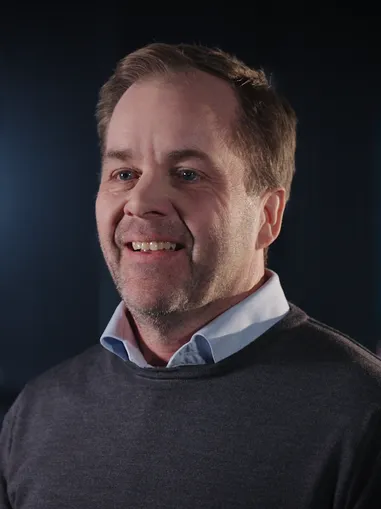
With one of the world's most advanced 5G networks, we can enable unbroken care chains within healthcare.
Drones can provide an earlier view of the accident site
The project also tests how drones can function as a first resource at an accident. A drone can be dispatched to the site and transmit live video to the emergency dispatch center before rescue personnel arrive.
The video gives operators the ability to assess the situation, determine what resources are needed, and coordinate the rescue operation more effectively. Drones can also be used to deliver critical medical equipment, such as a defibrillator, before the ambulance arrives.
5G Standalone and network slicing are used for drone control and high-quality video transmission. This way, the same 5G platform can be used for both ambulance communication and operations directly at the accident site.

Faster access to the right equipment
A large hospital has thousands of beds, medical devices, and other types of equipment. When equipment is moved between different departments, staff may need to spend valuable time searching for it.
By equipping devices with connected 5G units, their position can be shown in real time in an application on a mobile phone, tablet, or computer. Tests show that equipment can be positioned with accuracy within a few meters both indoors and outdoors.
This can make it easier for staff to quickly locate the right equipment when needed. More efficient positioning can also contribute to better utilization of the hospital's existing assets and reduced inventory costs.
The same network can support multiple parts of the hospital
The 5G platform is also used to connect sensors for facility and energy management. This means the same technical platform can support both clinical applications and the ongoing operation of the hospital.
The project thus tests how people, vehicles, medical equipment, sensors, and other critical resources can be connected through a shared 5G network, both inside the hospital and outdoors.
It's precisely the combination of multiple applications on the same platform that makes the project particularly interesting. Rather than testing only a single service, the project examines how advanced 5G can function as a long-term platform for continued innovation in healthcare.
NorthStar shortens the path from idea to real application
NorthStar is Telia and Ericsson's joint innovation program. Through the program, Swedish organizations gain early access to advanced 5G capabilities and the opportunity to test, develop, and validate new applications in real environments.
The 5GMHI project uses advanced positioning services and network slicing, among other features. By combining Telia's specially developed 5G network with Ericsson's 5G technology, participants can test new applications at scale and accelerate development from research and pilot projects to practical use.
NorthStar also creates a shared environment where industry, public sector, and other stakeholders can collaborate. This makes it possible to combine technical expertise with operational needs and develop applications that have the potential to be used beyond the individual project.

Three lessons for organizations looking to test 5G
Start with a concrete operational need
Identify a situation where better information sharing, positioning, or connectivity can make a real difference. Video communication from the ambulance is a clear example because the benefit extends all the way from transport to treatment.
Test multiple applications on the same platform
A shared 5G platform can be used for multiple needs, from ambulance video and drones to equipment positioning and connected sensors. This makes it possible to evaluate both individual services and the platform's overall potential.
Plan for deployment at scale
A successful test is only the beginning. For an application to create long-term value, the organization needs to examine early on how it can be integrated with existing systems, security requirements, and workflows.
A network that follows the patient's journey
5G can create new opportunities for integrated care where the right information becomes available earlier. Drones can provide an initial view of the accident site, the ambulance can be connected to the emergency department, and critical medical equipment can become easier to locate inside the hospital.
The technology doesn't replace the expertise of healthcare professionals. However, it can give staff better conditions to make informed decisions, prepare the right interventions, and deploy healthcare resources where they're needed most.